
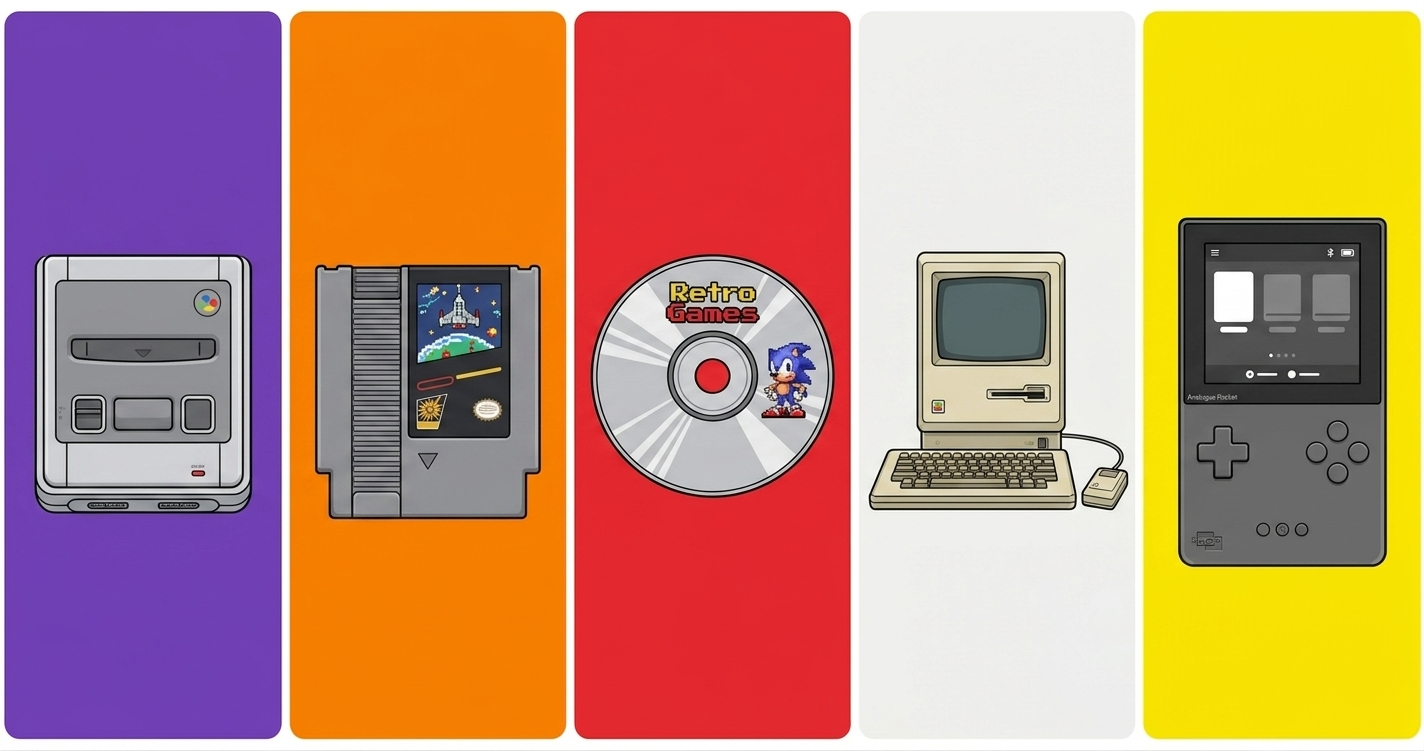
The popularity of retro handheld consoles and pixel-art classics has brought back a topic that often raises questions: emulation. In this article, we’ll explain in simple terms what emulation is, the role of emulators, what ROMs are, and how all this connects to copyright and piracy. The goal is to help you better understand how this technology works, what legitimate uses exist, and which precautions to take so you don’t run into legal trouble while revisiting your favorite games. At the end of the post, learn about some retro console models available on the market.
Legal Notice
The following content is for informational purposes only. Nothing here should be interpreted as encouragement of piracy or legal advice. Each reader is responsible for how they use emulators, ROMs, and ISOs, and for knowing and respecting their country’s copyright laws.
This post contains affiliate purchase links. When you buy through them, you help Tech Play Grid keep producing more content at no extra cost to you. For any questions about privacy or our affiliates, you can read our Privacy Policy and Affiliate Notice.
What is emulation?
When we talk about emulation in gaming, we mean programs that make a computer, phone, or modern console “behave” like an old video game system. In other words, an emulator imitates the original console’s hardware so you can run the same games on a completely different device.
In practice, this lets you play NES, SNES, Mega Drive, PlayStation 1 and many other classic system titles on PCs, phones, retro handhelds, or even modern consoles prepared for it. Many emulators also add features the original hardware never had, like save states, image filters, support for multiple controllers, and fast-forward.
What are emulators?
Emulators are the programs responsible for that “imitation” of the original console. They try to reproduce how the game system works internally: CPU, video, audio, controls and other components, so the game “thinks” it’s running on the device it was released for decades ago. There are emulators for a single console and multi-system emulators that run several consoles in the same interface. They are widely used by retro gamers, preservationists who want to keep old games accessible, and even developers who make new games for classic platforms.
It’s important to highlight: emulators by themselves are not automatically illegal. Emulation technology is legitimate; the problem lies in how and with what files it is used.
What are ROMs and ISOs?
To play something on an emulator, you need a digital copy of the game. These copies are usually called ROMs (when they come from cartridges) or ISOs/disk images (when they come from CDs and DVDs).
Simply put:
- ROMis the copy of a cartridge’s data, such as an NES, SNES, Mega Drive or Game Boy game.
- ISO or disk image is the copy of a game that came on optical media, like PlayStation 1 or 2.
Technically, it’s possible to create these copies from physical media you own, using specific equipment to dump cartridges or discs. However, on the internet most ROMs and ISOs are distributed by sites that don’t have authorization from the rights holders, which raises issues of piracy and copyright infringement.
Emulation is not the same as piracy
An important point is that emulation and piracy are not synonyms, although many people confuse them.
- Emulation is the technology that allows software to run on hardware different from the original.
- Piracy is obtaining, sharing or using copies of games without permission from the rights holders.
You can use an emulator to run:
- games you ripped yourself from media you own;
- games legally distributed in stores or official services;
- games released for free by their creators (homebrew or titles made free).
The same emulator can also be used to run ROMs downloaded from sites that offer entire libraries without authorization, which in most cases is considered copyright infringement. In other words, what defines piracy is the source of the game file, not the fact that you are using an emulator.
Copyright, ROMs and the piracy issue
Most commercial games remain protected by copyright for many years, even when the title is no longer sold officially. This means that, under many laws, downloading ROMs of games you did not buy, or that are distributed without permission, is considered copyright infringement.
Some points often discussed in legal contexts:
- An old or “out of print” game is not automatically legal to download.
- In some countries, the law may allow making a personal copy of a game you own, but this usually does not authorize downloading copies someone else uploaded to the internet.
- Companies like Nintendo and other major developers are strict about protecting their intellectual property and have sued ROM sites and projects linked to unauthorized distribution.
Laws such as the DMCA in the United States also have rules about circumventing technical protections (like DRM and encryption) to access games on modern consoles, which adds more complexity..
Because each country has its own laws and interpretations, the best approach is to learn about local legislation and, if in doubt, choose the most conservative path regarding copyright.
Emulation and preservation of retro games
Despite the controversies around piracy, emulation also plays an important role in preserving the history of video games. Many old consoles are physically deteriorating, spare parts are scarce, and several games are no longer sold, with no official way to access them.
Museums, researchers and preservation communities use emulators to document and keep the experience of these games alive for future generations. At the same time, official initiatives from companies are re-releasing collections or offering classic game catalogs through legal services, which gives legitimate options for revisiting those titles.
For the average player, safer paths include:
- prioritizing legal ways to play, such as official collections, digital re-releases and subscription services that include classic games;
- when using emulation, preferring files obtained legitimately and avoiding sites that distribute commercial game libraries without authorization.
Emulation is a powerful tool for those who love retro games and want to relive classics on modern devices, but it comes with responsibilities. Understanding the difference between emulation technology and piracy, knowing the legal limits and making informed choices are important steps to enjoy this world without disrespecting the work of those who created the games that marked our history.
Below are some console suggestions. Remember that by clicking these links you will be redirected to our partners’ sites and this helps Tech Play Grid keep bringing news and content :).
👉 Mini Console Premium Retrô 4K Com 20000 Jogos – VARENZIA
👉 Mini Console Retro Super Nintendo com 150 mil jogos
👉 Infanto 4 – Console Retrô com 44 mil jogos
👉 Video Game Retro Premium + 114 Mil Jogos – TOYUTOYI
👉 Mini Console Retro Super 3D Games com 150 mil jogos – SUPER 3D GAMES
Enjoyed our content? Want more tips on games, tech or buying suggestions? Follow us on our Social Media or visit our Contact page and sign up to receive more updates and content.